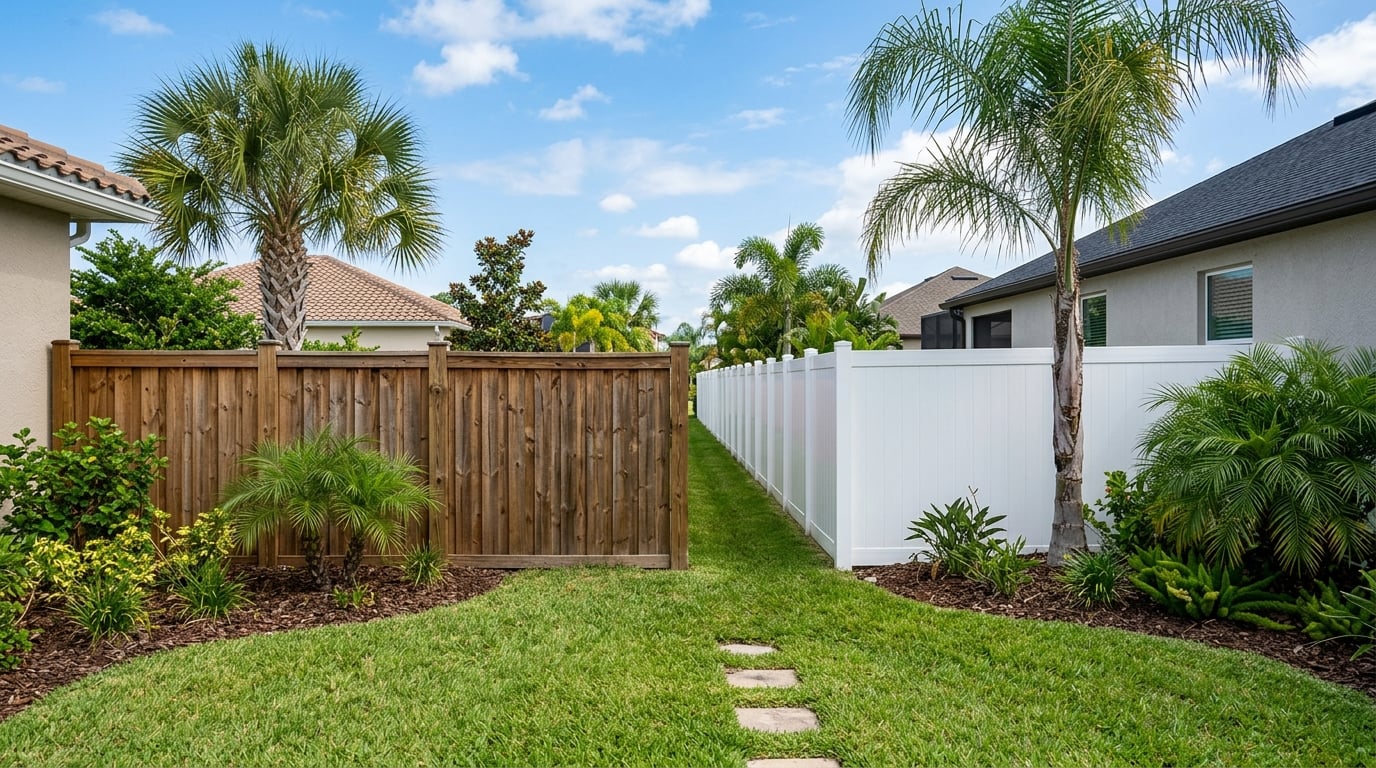
"Should I get wood or vinyl?" is the second most common question we hear (right after vinyl vs. aluminum). The honest answer: it depends on what you value more — upfront savings or long-term savings. Wood is cheaper on day one. Vinyl is cheaper by year five. Here's the math from a contractor who installs both materials every single week in Martin, St. Lucie, and Indian River Counties.
The Quick Answer
Wood wins for: Budget-conscious buyers who want a natural look and don't mind maintenance. Board-on-board and shadowbox styles offer a premium aesthetic that vinyl can't replicate. Great for short-term needs (5-10 years) or if you genuinely enjoy weekend projects.
Vinyl/PVC wins for: Everyone who wants to install it and never think about it again for 25+ years. Zero staining, zero painting, zero termite treatment. Higher upfront cost, dramatically lower lifetime cost.
Upfront Cost Comparison (100 Linear Feet, 6' Privacy)
Wood (Pressure-Treated Pine)
Vinyl/PVC Privacy
On day one, wood saves you $1,000-$1,500 on a typical 100-foot privacy fence. That's real money. But here's where the story changes.
The 20-Year Cost Breakdown
This is the table that changes minds. We're using real South Florida contractor pricing, not national averages.
| Cost Category | Wood (Pine) | Vinyl/PVC |
|---|---|---|
| Installation (100 LF) | $4,000 | $5,200 |
| Staining (every 2-3 yrs × 8 cycles) | $3,200 – $7,200 | $0 |
| Termite treatment / inspection | $400 – $800 | $0 |
| Board / post replacement (rot) | $500 – $1,500 | $0 |
| Full replacement (year 12-15) | $4,000 | $0 |
| Occasional cleaning / pressure wash | $200 | $200 |
| 20-Year Total | $12,300 – $17,700 | $5,400 |
| Vinyl saves over 20 years: | $6,900 – $12,300 | |
Read that bottom line again: vinyl saves $6,900 to $12,300 over 20 years compared to wood. The "cheap" fence is actually the expensive one.
Should You Stain Your Wood Fence? (Yes.)
If you go with wood, staining is not optional in Florida. Here's why:
- Florida UV exposure — We get 230+ sunny days per year. Unstained wood grays and cracks within 6-12 months.
- Florida humidity — 75%+ average humidity accelerates rot, mold, and mildew growth. Stain creates a moisture barrier.
- Termites — Formosan and drywood termites are endemic to South Florida. Pressure treatment helps but isn't bulletproof. Staining adds another barrier.
- Rain — 55+ inches per year. Water penetration is the #1 killer of wood fences in Florida.
Staining Schedule for Florida Wood Fences
Hurricane Performance
Wood: C+ — Solid wood privacy panels are the worst-performing fence type in hurricanes. They act as sails, catching full wind load. Posts snap at grade level, panels blow out, and the debris damages everything downwind. Insurance carriers know this — expect 50%+ depreciation on wood fence claims.
Vinyl: B+ — Modern vinyl is engineered with flex. Panels can bow without breaking and snap back after the storm passes. Failure mode is usually post lean (inadequate footing) rather than panel destruction. Lower depreciation on insurance claims.
Insurance Implications
This is the part nobody tells you. When your fence gets destroyed by a hurricane:
- Wood fences receive higher depreciation rates (often 50%+). Carriers argue wood was already aging/deteriorating before the storm.
- Vinyl fences receive lower depreciation because the material doesn't age the same way — no rot, no mildew, no weathering to depreciate.
- Replacement documentation is simpler with vinyl — one product, one SKU. Wood requires species, grade, treatment level, stain type, and labor documentation.
If you live in a hurricane zone (all of South Florida), this insurance math alone can justify vinyl over wood.
When Wood Is the Right Choice
We install wood fences regularly and they have legitimate use cases:
- Aesthetics matter most — A stained cedar board-on-board fence is genuinely beautiful. Vinyl can't replicate real wood grain and warmth.
- HOA requires wood — Some older communities mandate natural wood fencing.
- Short-term need — If you're selling the property in 3-5 years, the lower upfront cost makes sense.
- Custom work — Arched gates, curved runs, stepped grading on slopes — wood is easier to customize in the field.
The Bottom Line
For 20-year cost: Vinyl wins by $7,000-$12,000.
For zero maintenance: Vinyl. It's not even close.
For hurricane zones: Vinyl performs better and gets better insurance treatment.
For pure aesthetics: A well-maintained stained cedar fence is hard to beat visually.
Most of our customers who start by asking for wood end up choosing vinyl once they see the 20-year math. The ones who still choose wood? They know exactly what they're signing up for — and they love the look enough to maintain it.
Frequently Asked Questions
Should I stain my wood fence in Florida?
Yes — absolutely. Unstained pressure-treated pine in Florida will gray, crack, and begin rotting within 2-3 years. A quality penetrating oil stain (not film-forming paint) should be applied within 3-6 months of installation and re-applied every 2-3 years. Budget $4-$9 per linear foot per side for professional staining. Double-sided staining runs $7-$15/LF. This is the single most important maintenance decision for a wood fence in Florida.
How long does a wood fence last in Florida?
Pressure-treated pine with proper staining every 2-3 years lasts 12-18 years. Cedar lasts 15-20 years with staining. Without staining, expect 5-8 years before major rot and structural failure. Vinyl fences last 25-30+ years with zero staining or treatment.
Is a vinyl fence cheaper than wood over 20 years?
Yes. A 100-foot vinyl privacy fence costs roughly $4,500-$6,000 installed with near-zero maintenance for 20 years. The same wood fence costs $3,500-$5,000 installed but requires $1,600-$4,800 in staining over 20 years plus one full replacement at $3,500-$5,000, totaling $8,600-$14,800. Vinyl saves $4,000-$9,000 over 20 years.
Does wood fencing affect my insurance in Florida?
Yes — wood fences are classified as higher risk for wind damage claims. Solid wood panels act as sails in hurricanes, and carriers often apply 50%+ depreciation to wood fence claims. Vinyl and aluminum fences typically receive lower depreciation rates because they are engineered for wind resistance.
What is the best wood for fencing in Florida?
Pressure-treated Southern Yellow Pine (SYP) is the most common and affordable option. For premium installations, Western Red Cedar offers better natural rot resistance and a richer appearance. Never use untreated pine, spruce, or fir — they will rot within 1-2 years in Florida humidity.
Need Help Deciding?
We install both wood and vinyl every week. Get a free on-site estimate with real pricing for both options — side by side.