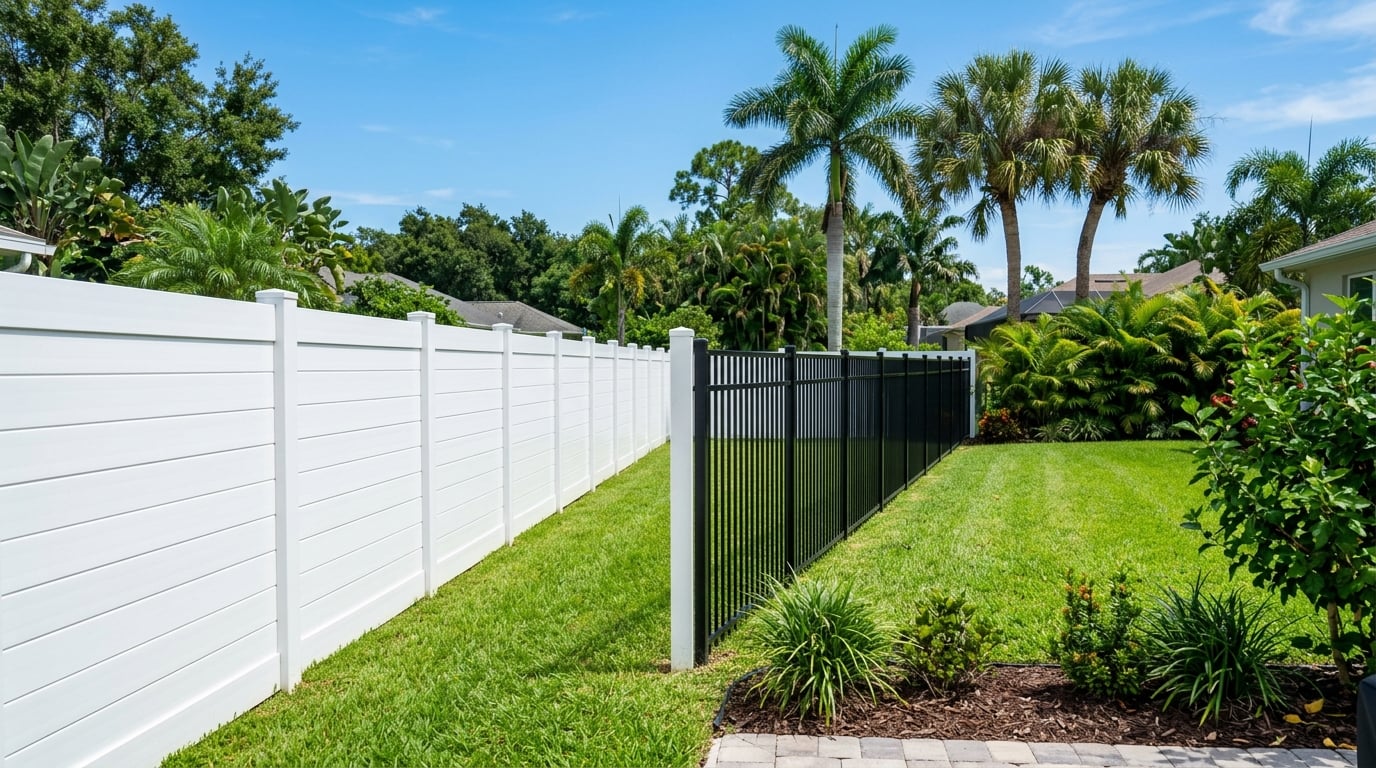
This is the question we hear more than any other: "Should I get vinyl or aluminum?" The answer depends on what you need the fence to do, where your property is, and how much maintenance you\'re willing to accept. Here\'s the honest breakdown from a contractor who installs both materials every single week in Martin, St. Lucie, and Indian River Counties.
The Quick Answer
Aluminum wins for: Pool fencing, decorative/picket fencing, coastal properties (salt air), low-profile boundaries, and any application where you need to see through the fence.
Vinyl wins for: Privacy fencing, noise reduction, wind blocking, and any application where you want a solid barrier between you and the outside world.
That\'s it. If you want privacy, vinyl. If you want see-through or decorative, aluminum. Everything else is nuance — but important nuance if you\'re spending $5,000-$25,000 on a fence that needs to last 20+ years in Florida.
Salt Air Performance
Aluminum: A+ — Aluminum cannot rust. It is inherently corrosion-resistant at the molecular level. Even in direct oceanfront conditions on Hutchinson Island or the Jupiter Inlet, properly installed aluminum with stainless steel fasteners will last decades without visible corrosion.
Vinyl: A- — Vinyl itself doesn\'t corrode, but it can become brittle in extreme UV/salt environments over 15+ years. The bigger issue is that vinyl fences have metal internal reinforcement — and if that reinforcement isn\'t galvanized or stainless, it can rust from the inside out, causing the vinyl to crack and bulge. We use vinyl products with aluminum or galvanized steel reinforcement to prevent this.
Hurricane Performance
Aluminum: B+ — Aluminum picket fencing handles hurricanes well because wind passes through the pickets. The failure mode is usually post lean (inadequate footing) rather than panel destruction. Properly set posts in concrete at 24-30 inch depth survive most Category 1-2 events without damage.
Vinyl: B- — Privacy vinyl acts as a sail in high winds. The solid panels catch wind load and transfer it to the posts. The most common failure mode is post snap at grade level or panel blow-out. We engineer post spacing at 6-foot maximum (not the 8-foot some manufacturers allow) to reduce this risk.
Maintenance Required
Aluminum: Near-zero. Occasional rinse with a garden hose. Powder coating lasts 15-20 years. No painting, no staining, no sealing.
Vinyl: Near-zero. Occasional rinse with a garden hose. May need pressure washing for mildew in shaded areas. No painting, no staining, no sealing.
Both materials are genuinely low-maintenance in Florida. Wood is where maintenance becomes a real burden — annual staining or painting, rot repair, and insect treatment.
Lifespan in Florida
- Aluminum: 25-40+ years (powder coating may need refresh at 15-20 years)
- Vinyl (premium): 20-30 years (UV stabilizers degrade over time)
- Vinyl (cheap): 8-15 years (yellowing, cracking, brittleness)
- Wood (for comparison): 10-20 years with active maintenance
The difference between premium and cheap vinyl is enormous. Budget vinyl from big-box stores uses less UV stabilizer, thinner walls, and inferior reinforcement. It looks great for 2-3 years, then yellows, cracks, and becomes brittle. Premium vinyl (what we install) uses titanium dioxide UV protection, impact-modified PVC, and thicker wall sections.
Cost Comparison (Installed, Treasure Coast)
Our Recommendation
For most Treasure Coast homeowners, here\'s our blunt recommendation:
- Pool fence: Aluminum. Always. It\'s code-compliant, see-through (required for supervision), and handles salt air perfectly.
- Privacy fence (inland): Vinyl. Zero maintenance, solid barrier, no rot risk. Just make sure it\'s premium-grade.
- Privacy fence (coastal): Vinyl with aluminum reinforcement. Standard steel reinforcement will rust near the coast.
- Decorative/front yard: Aluminum. It looks premium and doesn\'t block sight lines.
- HOA community: Whatever the HOA requires — we prepare the submission package for either material.
Need Help Deciding?
We do free on-site estimates across the Treasure Coast. We\'ll look at your property, discuss your goals, and recommend the right material — even if it\'s the cheaper option.