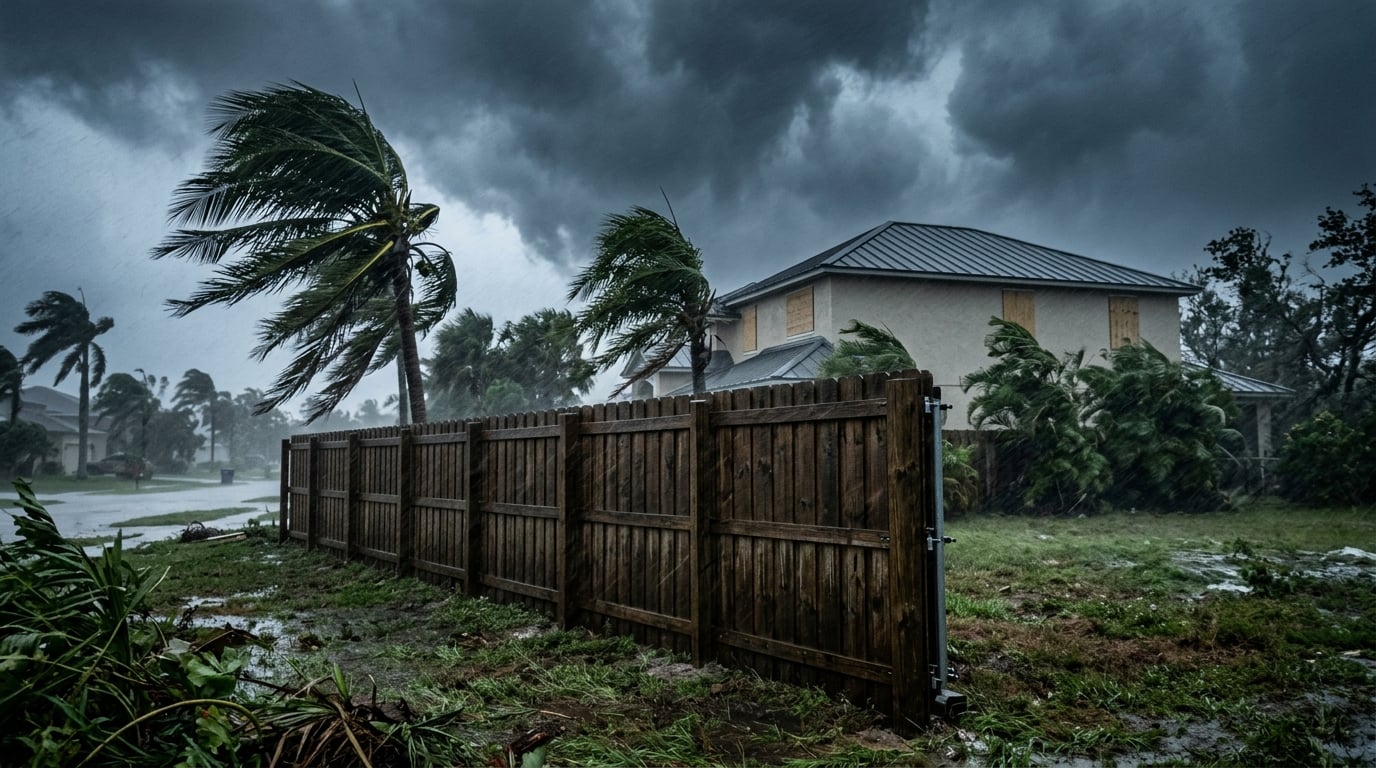
Hurricane season runs June 1 through November 30 in Florida — six months every year where your fence faces the real possibility of tropical-force or hurricane-force winds. Living on the Treasure Coast means this isn\'t theoretical. We rebuild fences after every major storm, and we see the same preventable failures over and over. This guide covers what you can do before, during, and after a storm to protect your fence investment.
Pre-Storm Inspection Checklist
Do this inspection at the start of hurricane season (June 1) and again before any named storm enters the forecast cone:
- Check every post. Push hard against each post at the top. If it wobbles more than 1 inch at the top, it needs repair. A loose post will fail first in high winds.
- Inspect post bases. Look for cracking concrete, soil erosion around the base, or visible rot (wood posts). These are the #1 failure points in hurricanes.
- Tighten all hardware. Screws, bolts, hinges, and latches loosen over time. Walk the entire fence line and tighten everything. Replace any rusted fasteners with stainless steel.
- Check gate alignment. Gates that drag or don\'t latch properly will swing uncontrolled in wind and damage themselves and adjacent panels.
- Clear the fence line. Remove any items stored against the fence: ladders, lawn furniture, potted plants, toys. These become projectiles in high winds.
- Trim overhanging trees. Branches within 10 feet of your fence are the #1 cause of storm damage. The tree falls on the fence, not the wind.
- Document with photos. Photograph your entire fence before storm season. This documentation is critical for insurance claims if damage occurs.
During the Storm
There is nothing you can safely do to your fence during a hurricane. Stay inside. The fence is replaceable — you are not.
If you have a vinyl privacy fence and have advance warning (24+ hours), you can remove individual panels to let wind pass through the posts. This dramatically reduces wind load. Re-installing panels after the storm takes 30 minutes to an hour. Not all vinyl fence designs allow easy panel removal — check before the storm arrives.
After the Storm: What to Do First
- Safety first. Watch for downed power lines near your fence. If a power line is on or near your fence, stay away and call FPL (Florida Power & Light) immediately. Do not touch the fence.
- Document damage. Photograph everything before you move or repair anything. Your insurance company needs pre-repair documentation.
- Secure immediate hazards. If your pool fence is down, that\'s an immediate safety issue — especially if you have children or pets. Temporary fencing or barriers should be installed same-day.
- Contact your insurance company. File the claim early. After major storms, adjusters are overwhelmed and response times increase dramatically.
- Contact a professional fence contractor. Get a professional assessment and written repair estimate. This documentation supports your insurance claim.
Before You Hire: Verify the Contractor
After a storm, out-of-town "storm chasers" flood the area. Protect yourself — always confirm a contractor is legitimate before signing anything or paying a deposit:
- Check their contractor\'s license and confirm it\'s active and in good standing.
- Verify their state business registration (in Florida, look them up on Sunbiz).
- Look them up on trusted credential directories like SCC to confirm insurance, bonding, and license status.
You can verify contractor credentials at ContractorCreds.com. Allied Fence & Gates is fully licensed, insured, and bonded — and we\'re happy to provide our credentials on request.
Insurance Claims: What You Need to Know
Fence damage from named storms is typically covered under your homeowner\'s insurance policy:
- Coverage B ("Other Structures") covers fences. This is typically 10% of your dwelling coverage. If your home is insured for $300,000, you have up to $30,000 for other structures including fences, sheds, and detached garages.
- Hurricane deductible applies separately. Many Florida policies have 2-5% hurricane deductibles. On a $300,000 policy, that\'s $6,000-$15,000 before coverage kicks in.
- We work with insurance. We prepare detailed repair estimates, provide documentation, and work directly with your adjuster. We do this after every major storm.
Building a Storm-Resistant Fence
If you\'re installing a new fence or replacing one destroyed by a storm, here\'s how to build for hurricane resistance:
- Deeper post footings — 24-30 inches in concrete, minimum. The standard 12-inch depth fails in high winds. We dig deeper on every installation.
- Tighter post spacing — 6-foot maximum for privacy fencing (not 8-foot). Closer posts share wind load better.
- Aluminum over vinyl for wind zones — Aluminum picket fencing lets wind pass through. If you need privacy AND wind resistance, consider aluminum privacy with louvers.
- Stainless steel hardware — Standard hardware weakens with corrosion over time. Stainless steel maintains full strength decade after decade.
- Proper concrete mix — We use high-strength concrete (4,000 PSI minimum), not fast-set bags that crumble in wet conditions.
Storm Damage? We Respond Fast.
After every major storm, we prioritize emergency repairs: pool fences down, dogs out, immediate safety hazards. Insurance documentation and full rebuilds follow.